By Emma Thai
After COVID-19 forced Washington and Lee University to switch to remote classes, professors and administrators are trying to keep the hallmark small classes and professor relationships alive, while also maintaining academic rigor.
During a Zoom interview, Paul Hanstedt, the Director of W&L’s Center for Academic Resources and Pedagogical Excellence, said that he is encouraging W&L professors to maintain normalcy in their classes. He thinks that professors should focus on showing their personalities, even in the online classroom.
“I’m encouraging people to allow their sense of humor to come out,” Hanstedt said. “Whatever they used in the classroom to make the classroom work should appear in their emails, should appear in their videos.”
On March 13, W&L announced that students would have to move home by March 18, unless they received special permission to stay. Classes resumed remotely two weeks later on March 30 to give professors time to plan for the change.
A study published in the Journal of Higher Education on community colleges in Washington state found that online higher education leads to reduced student performance in every subject. Performance was measured by change in grade and change in student persistence, which was determined by how many students withdrew from classes.
While this study does not necessarily translate to W&L’s transition to online classes, it does show how much online classes could have an impact on students.
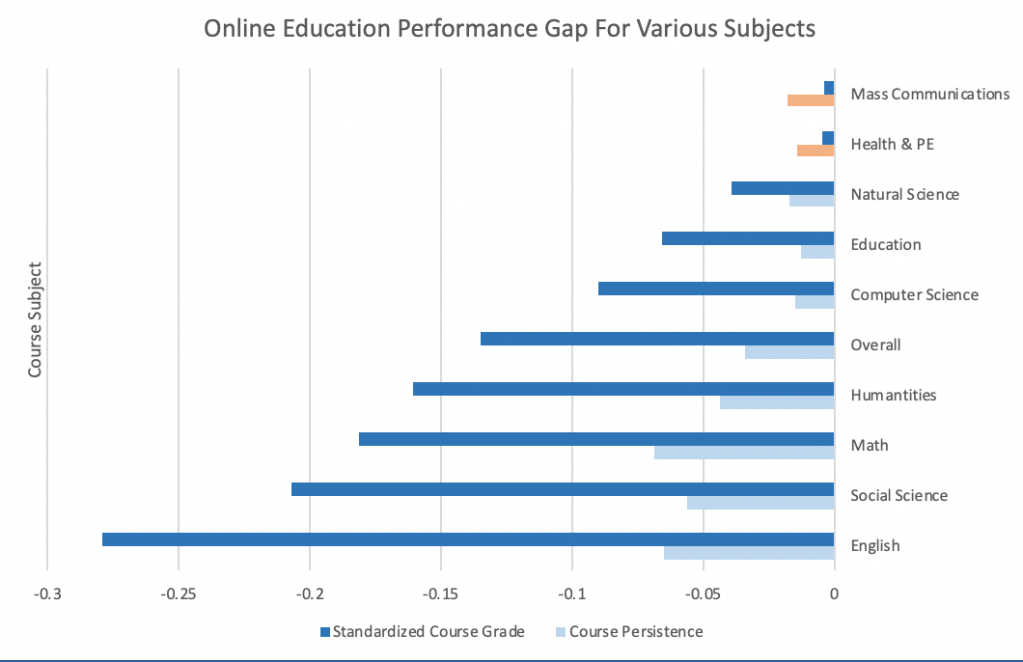
According the study, mass communications and physical education were the only two subjects with almost the same outcomes in online and face-to-face classes.
Jessica Miller, who teaches W&L’s Interpretive Movement P.E. class, believes that classes like hers are beneficial to students while at home.
“Students have said it has been helpful in grounding them in uncertain times,” she said in an online interview. “My class has a focus on mental clarity as well as movement and students say it given them a sense of relaxation and helped them sleep.”
Although P.E. and journalism are not similar in terms of content, they both focus on action and skills rather than just information.
Professor Douglas Cumming of the Journalism and Mass Communications Department, is grappling with keeping the rigor of Journalism 201: Introduction to News Writing remotely. Journalism 201 includes a combination of in-class writing labs and lectures so that students learn how to effectively write for news.
Cumming changed the class so students were focusing more on the in-class writing labs and feedback than lectures. He actually thinks he and his students are able to commit more time and energy to the course being at home.
“I do think the pedagogy in some ways is even richer,” he said in an interview over Zoom yesterday. “I feel like I can spend more time emailing and editing student work. I’m actually excited about some of the new possibilities.”
When asked about the data in the study, Cumming mentioned that the data on student grades are not a good model for W&L because many professors will not grade as harshly due to the unforeseen circumstances. The study only accounted for students who chose to take online or in-person classes, but W&L students and professors did not have a choice.
“I feel like I’m being more generous with grading,” he said. “It was sudden, and we were thrust into this, so it’s nobody’s fault if there are difficulties.”
W&L will let students choose to take classes credit/no-credit with no impact on their GPA to account for unexpected grade changes.
Professors and administrators also have the added layer of W&L students feeling socially isolated while staying at home.
Julia Gallop is a W&L student who understands remote learning better than most W&L students. After a vacation to Italy over Washington Break, Gallop and her friend Paige Hammele were quarantined at W&L and not permitted to attend classes or be around other students for two weeks.
Gallop said that she felt isolated, both in the classroom and socially. When asked what she missed most, Gallop responded, “I really missed my friends. I missed social interaction in general.”
In order to offset this social isolation, Hanstedt wants professors to cultivate the same relationships they’ve always had with students.
“Yes, you want to establish the structures of the course,” he said. “But, also, you need to reestablish the relationships.”
Cumming had the same outlook on how important relationships with students are.
“What’s unique and what’s definitive about liberal arts is the relationships between professors and students,” he said. “The learning is what happens in between.”
But Hanstedt said that a lot of his work was made easy because of the intelligence and drive of the W&L community.
“One of the real pleasures of this is watching really smart people and really smart teachers innovate and come up ways to handle things,” he said. “It’s impressive. It really is.”
Works Cited
Xu, Di and Shanna S. Jaggars. “Performance Gaps Between Online and Face-to-Face Courses: Differences Across Types of Students and Academic Subject Areas.” The Journal of Higher Education, vol. 85 no. 5, 2014, p. 633-659. Project MUSE, doi:10.1353/jhe.2014.0028.
###
This article was written in April 2020 during my digital journalism course. I conducted all the interviews and research via Zoom since we were remote. I initially created this whole website to host this article, so I had a place to display all my multimedia work together.
 Emma Pippin Thai