Introduction:
This audit is a comprehensive review of Project Horizon’s internal and external communications. Kaitlyn Kaufman, a member of Project Horizon’s community outreach team, provided an in-person interview, as a well as an on-site tour to gain context about what Project Horizon is and what the goals are. An online survey was sent out to employees and volunteers at Project Horizon to assess the internal communications within the organization. Social media platforms Instagram, Facebook, and Twitter were used to analyze social media communication. To respect the privacy and safety of those who Project Horizon help, no clients were interviewed or fielded for information on internal communications.
Situation Analysis:
Project Horizon is a non-profit organization that focuses on helping victims of domestic abuse and sexual violence in Rockbridge County, Virginia. Unlike traditional for-profit organizations, Project Horizon has two primary target audiences. One primary target audience is low-income, rural women and children who are at risk of being abused. This target audience is typically not highly educated and may not have as much access to digital forms of media. Although the demographics of Rockbridge County are predominantly Caucasian, they do have special outreach programs for women and children of color. Similarly, Project Hrozion also offers support for college women or any other women in the Rockbridge area who are experiencing abuse. The other primary target audience is members of the community with resources to volunteer or donate to Project Horizon. Given that it is a non-profit, it needs the help of community members to continue helping people in need. This target audience is highly educated and of a higher socio-economic status. Ms. Kaufman’s goals for communication are name recognition and volunteer recruitment. She wants people to recognize PH’s name so that, if they need help, they know where to go. On the other side, PH wants people to donate time or money to help it continue running its operation.
External Communication
Social Media Use
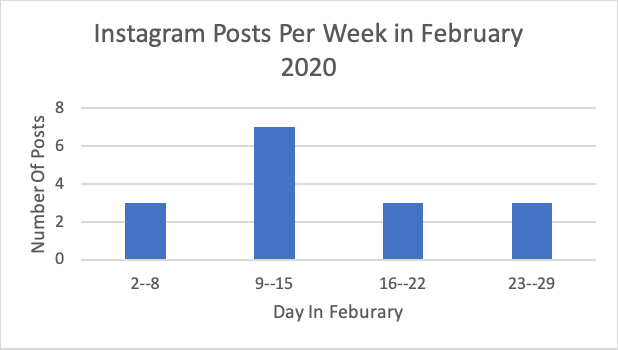
Ms. Kaufman outlined that social media, while being an important aspect of its overall external communications, is not somewhere that Project Horizon feels they need to improve. The social media platforms they predominantly use are Facebook, Instagram, and Twitter. Its Instagram (@projecthorizon120) has a consistent visual brand. They intersperse inspirational and empowering quotes such as “you deserve love” with infographics to spread awareness about domestic abuse. The posts are always colorful and engaging, even when they reference difficult topics. They don’t seem to have a consistent posting schedule, but they do post regularly. The data visualization below depicts its posting over the month of February.
Some of its highest engagement (likes and comments) are in its infographics because they serve as being both educational and visually appealing (averaging about 60 likes per post). Its announcement posts, while necessary, do not get as much engagement (sometimes as low as 12 likes per post). On Facebook, Project Horizon seems to have identical content as Instagram. Twitter (@projecthorizon2) also posts identical content to Instagram and Facebook. However, similar organizations in Lexington such as Yellow Brick Road (a children’s education program), do not even have social media. Therefore, Project Horizon’s social media use is already more advanced than its competition.
Website
The Project Horizon website clearly outlines the goals of the organization and makes services easy to reach. Its 24-hour hotline is bolded across the top the audience knows exactly how to reach them for personalized assistance. The 24-hour hotline allows people in crisis to contact Project Horizon and get immediate help. The website also features sections such as “volunteering” and “donations” which allow visitors to get involved without needing to search for that information. Much like its Facebook page, the website includes an “events” tab where visitors, who may not be on Facebook can view upcoming events.
Tangible Communication
Project Horizon communicates using fliers and posters in the bathrooms of schools and grocery store to reach women and/or children, who may not have access to social media. One of Project horizon’s most unique and effective forms of communication is the merchandize that volunteers distribute. Items such as phone wallets, phone pop-sockets, and refrigerator magnets with Project Horizon’s name and phone number are given out for free, so that they can increase its name-recognition in a tangible way. For its rural target audience, this method of communication may have more traction than social media, because people who do not have consistent internet or do not want their abusers to know that they are searching for Project Horizon on the internet. Also, items such as the refrigerator magnet may foster communication similar to word-of-mouth in which people see the magnet on their friends’ fridges and then remember Project Horizon’s name.
Recommendations for External Communication
Although email is a key aspect of its internal communication, the Project Horizon team does not use any form of email for external communication such as a newsletter. According to Ms. Kaufman, several donors and volunteers have mentioned a desire for such a newsletter. A monthly newsletter to update the public on what Project Horizon is doing and its accomplishments could be helpful to keeping both target audiences involved. The newsletter could be both in email form and printed to reach the largest audience.
Similarly, posting more unique content to Facebook and Twitter rather than just reposting the same content on all three platforms could be an effective method of getting its message out to reach different people. For example, Facebook lends itself to longer text, so even having an online newsletter posted on Facebook could work. Twitter only allows for short text, so Twitter could be for announcements. The Instagram page is currently very effective, but its visuals are only really effective on Instagram. The content doesn’t necessarily translate to the other platforms.
The Project Horizon website has all of the content that it needs; however, the aesthetics of the website could be improved and modernized. More clean and simple graphics with fewer tab options would make the website easier to navigate.
One area that Project Horizon is very strong in is its use of tangible communication. The phone accessories and magnets encourage people to know exactly what it is and what it does. Flyers in bathrooms are a great way to let women with limited resources know how to contact Project Horizon in a safe way. One opportunity for PH to improve and reach more of its rural target audience is to put up flyers in churches in the area or have seminars describing what it does.
Internal Communication
Overall Effectiveness
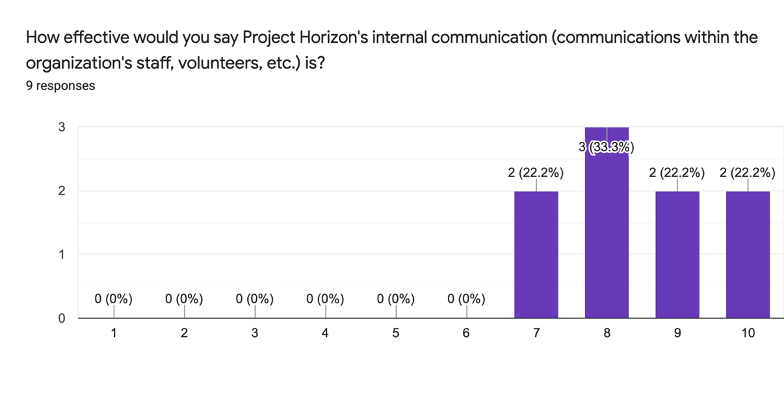
A Google Form was used to ask employees and volunteers of Project Horizon about their thoughts on Project Horizon’s communication. All nine people who took the survey classified Project Horizon’s communication as being very effective. When asked to rate its effectiveness on a scale from 1-10, all responses fell in the range of 7-10, with the most responses for 8. This data is on the chart below. This means that the majority of employees believe Project Horizon to be very effective at internal communication, but there is still room for some improvement.
Online Communication
When asked what forms of communication are used most often, all nine responses said that email was the most used. Email is a very productive tool for formal communication among organizations, but it does have some limitations. While all nine respondents said that they felt email was an effective method of communication, many also asked for another form of direct communication that is more private.
Respondents also mentioned use of the volunteer management platform GivePulse. GivePulse allows for volunteers and organizations to track hours and post volunteer opportunities. No respondent gave details about the benefits or detriments of this platform, but it seems to be productive for the organization to advertise themselves and keep track of how volunteers are doing.
Other Forms of Communication
One weakness in terms of internal communication for Project Horizon is the usage of in-person and paper communication without any online follow-up. Three out of nine respondents to the Google Form mentioned that many times they were given sticky notes or reminders in person that they lost or forgot. All three classified this communication as “least effective.”
Recommendations for Internal Communication
Much like with external communication, an in-house newsletter could be a good tool to foster employee relations and a culture of open communications. This could be weekly or even monthly and would include what each member of the team has been working on, major projects, important news and events, and even volunteer introductions or events.
Another recommendation would be to implement another messaging tool separate from email. Given the subject matter that many Project Horizon team members discuss, a more protected communication method such as WhatsApp for individual messaging or Groupme for group messages could be a valuable tool.
Seven out of nine respondents asked for some form of online calendar instead of the whiteboard calendar that is currently used. An app such as Google Calendar or Outlook could be efficient for putting up staff hours, appointments, and meetings, so people can access them anywhere online.
It would also be advantageous to focus more on online communication rather than paper notes and in-person communication so information can be conveyed more efficiently. A program such as Slack, which is an instant messaging platform for workplaces, could fix many of these internal communication problems for Project Horizon. It would able them to communicate individually and as a group in a private format that cannot be accessed by outside persons. It would also allow for announcements and events to be published to the entire organization, to limit the use of the whiteboard calendar. Instead of leaving a note for a colleague, an employee could just send a message on Slack.
Conclusions
Project Horizon is relatively advanced with all forms of external communication compared to similar non-profit organizations. However, improvements could definitely be made in terms of creating a newsletter, broadening social media content, and increase online internal communications.
###
This project was made during my Public Relations Writing class. I did a communications audit for our community partner, Project Horizon, a domestic and sexual violence resource organization in Lexington, VA. This audit included their internal and external communications, as well as interviews from members of the organization and their volunteers.
 Emma Pippin Thai