Analytics Report: Multiple vs. Single posts on Instagram and Instagram Stories

Analytics Report: Multiple vs. Single posts on Instagram and Instagram Stories

By Emma Thai

Introduction

At its conception, Instagram had one simple functionality in the social media space: the ability to post a single photo at a time. This meant that a user could post as many single photos as they wanted to appear on their feed, but they had to be posted separately. That functionality changed as users desired more content and the ability to post more content. Today, the platform allows up to 10 photos in a single post, with unlimited photo sharing abilities through story functions. As the limit for photos became much larger, accounts took advantage of those new capabilities, and many users post multiple images at a higher rate than single.

The Gennies’ Daily Instagram account has followed the new conventions of posting multiple photos at a time. However, single image post functionality still exists, and users still respond to and interact with single posts. An analysis was conducted on The Gennies’ Daily Instagram account to determine if single or multiple posts generated better audience engagement from 2020 and 2022.

Research questions and hypothesis

Research Question: For posting on Instagram grid and Instagram stories, are multiple images or only a single post more successful?

Hypothesis: Multiple story posts will be more successful than single, but there will be no difference between carousel and image posts.   

Method

To answer this question, data was collected from Instagram Creator studio. Instagram stories data was inputted by hand, with “multiple” stories meaning multiple story posts that related to the same overall topic. Story posts would be labeled “single” or “multiple” depending on this distinction. Since stories have video length limitations, many of these posts would be videos that were separated into multiple, smaller clips. Other multiple stories included stories where the information didn’t fit on one slide or response stickers that only allowed for one response per story. The Instagram story data from 2020 had no information on single/multiple, and it was difficult to identify which stories went together from the posts alone. So, the Instagram story data is limited to just 2022.

Instagram grid data was able to be downloaded from Creator Studio into an Excel sheet. Unlike Instagram stories, Instagram labels each post as “IG Image,” a single image post, or “IG Carousel,” a post with multiple photos that a user can scroll through. In 2020, Instagram had not released its Reels feature yet, so video posts were still a popular feature. Any video posts were omitted from the data set for this study.

“Success” in the context of this report, refers to average to the following factors for each post format. Likes and reach show the number of people who interacted with or viewed the content, and impressions show the total number of times that the content was seen to determine if there is a difference in terms of the algorithm.  Exits show the number of people who exited stories after viewing an individual post, which represents a deliberate action to stop seeing the content. Exits would be considered a negative factor in measuring success. Although shares and replies were considered as methods of measuring success, so few posts were shared, it would only account for a few outliers.

FormatSuccess Metrics
Instagram Post (Carousel vs. Image)Likes, Reach, Impressions, Engagement Rates
Instagram StoryImpressions, Exits, Exit Rates

Engagement rates were calculated by dividing likes, comments, and shares by impressions, and exit rates were calculated by dividing total exits by impressions. Engagement rates for 2020 did not include shares because Instagram did not provide that information.

Sample

The sample size for each of the data sets varied greatly because of the differences in nature for each posting format. Stories tend to include far more regular content since it only stays up for 24 hours. Grid posts are much less frequent and tend to take up less of the overall posting percentage. For traditional Instagram grid posts, carousel posts are more frequent than single posts.

 Winter and Fall 2020Winter 2022Total
Carousel Post471966
Image Post43649
Single Story0125125
Multiple Story09191
Excluded Videos13013

Results

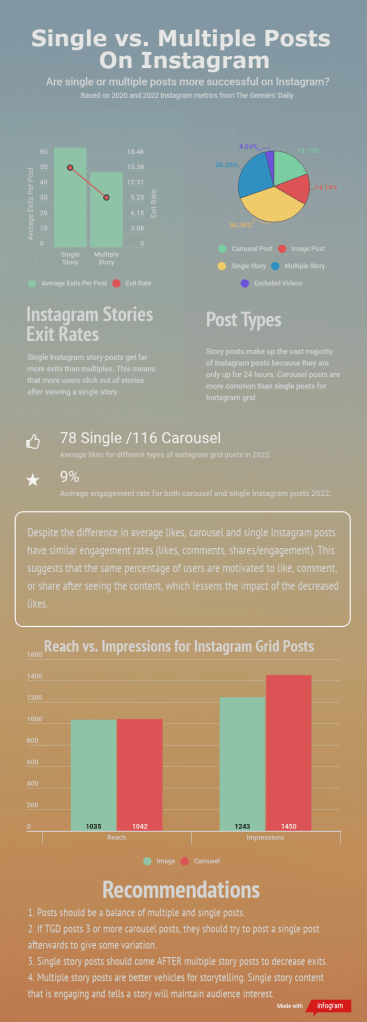
Carousel and single posts had almost identical reach with 1042 and 1035 respectively. In 2022, single-image posts had a higher average reach than carousel posts (1152 vs. 1061). However, carousels gained significantly more likes than single posts on average. Carousels received an average of 128 likes vs 90 for single posts. In both 2020 and 2022, carousel posts maintained about 30% more likes than any given single post. Although carousel posts had more likes, their respective engagement rates were less than 1% different.

Multiple story posts gained more impressions. However, the difference was less noticeable with a 10% difference from single posts. Multiple posts received 460 impressions on average vs. 417 for multiple.

The primary separating factor between single and multiple posts is in exits after the post. Single posts had almost 25% more exits than multiple posts, with an exit rate of 16%, vs 10% for multiple posts.

Analysis
The data seems to support the initial hypothesis that multiple Instagram story posts will be more successful than single posts. However, it suggested that carousel posts are more successful than single posts when looking solely at likes and impressions.

For stories, multiple posts tended to receive more impressions. Impressions only mean that there are more total views of the post. More importantly, the difference in exits is reflective of a significant separation in usage between the two. Exit rates are valuable because they show a user’s intentional choice to finish watching content on stories. There are many reasons for someone to click out of stories that aren’t all inherently tied to the content they are viewing (for example, deciding to close the Instagram app entirely), but it should still be as low as possible if the content is engaging. Multiple posts tend to keep a users’ attention longer because the content is more connected and potentially more interesting.

The “Daily Rundown” and “Headlines” posts that were posted each morning are considered single posts. This could also explain the greater exit rate. Those posts are the same every single day, so some students may click on them and see the news or events they need to know for the day and click off. “Daily Rundown” posts average about 68 exits per post, and “Headlines” posts average about 67 exits per post, both of which are slightly higher than the overall average for single stories (65 per post).

Multiple posts tend to allow for an actual story to be told, rather than just one point of news. Multiple stories can take the form of video interviews, student reactions to questions, and food reviews.  One-off posts are a single picture of the colonnade or a graphic promoting a campus event.

For Instagram grid posts when there are multiple images in a post, there is a higher chance of getting more likes because carousel posts receive more likes, comments, and impressions on average. There is only a slight difference in engagement rates (less than 1% for each year, respectively) for these two types of posts. This means that the percentage of impressions that lead to actions is about the same. Based on the data, a carousel post will garner more likes overall, but not necessarily more likes per impression. This could suggest that the Instagram algorithm prioritizes carousel posts over single posts, and followers don’t prefer one format over the other.

This data shows that single Instagram posts aren’t inherently invaluable because they get fewer likes. Carousel posts should continue to be more of a priority. But for The Gennies’ Daily’s primary goals, namely campus engagement and showing the community content they would enjoy, there is minimal evidence to show that single posts aren’t as well enjoyed as carousel posts. And they have a similar reach, suggesting that they are just as likely to be shown to unique users as carousel posts.

Recommendations

Based on the analysis and research above, The Gennies’ Daily should pursue a balance between single and multiple posts to take full advantage of their engagement potential. Although carousel and multiple story posts tend to garner more attention and engagement from the audience, single posts still have a similar rate of engagement. If TGD posts 3 or more carousel posts, they should try to post a single post afterward to give some variation. Sometimes single posts are more practical, especially for certain essential news, and there’s no major difference in reach, so it is unnecessary to make a valuable post a carousel just to get more attention.

Similarly, the dynamic between multiple and single-story posts can be used to TGD’s advantage. Followers are less likely to exit a post after a multiple story post, so if TGD can post a single post after multiple posts rather than vice versa, they might be able to maintain a follower’s attention for longer without exiting stories afterward. TGD should also try to make single posts more engaging, with storytelling elements, even if they aren’t as long as multiple posts. Single graphics to promote events or give necessary information are important. However, the regularly scheduled single posts such as “Headlines” and “Daily Rundown” could be more engaging with student opinions on headlines or images that change each time.

###

This analytics report was conducted during my Winter 2022 social media class. We had to analyze one aspect of The Gennies Daily’s social media accounts. I looked into the differences in engagement and success in multiple vs. single Instagram posts from 2020-2022. I used Instagram Creator Studio and Microsoft Excel for all of the data analysis. I used Infogram to make my final one-page infographic.
Tinder Advertising Campaign

Tinder Advertising Campaign

This advertising campaign was made during AdClass in Winter of 2021. We were a part of the American Advertising Federation’s National Student Advertising Competition (NSAC). We were tasked with creating a full advertising campaign for Tinder with a $10 million dollar budget. I was a media strategist, so I focused on our budget and media timeline to determine the best placements for our ads. Click below to see the pdf of our final plans book!

Social Media Samples

Social Media Samples

Below are social media posts I made for various organizations. All graphics were made using Canva.

Ring Tum Phi- Washington and Lee’s Only Independent Student Run Newspaper

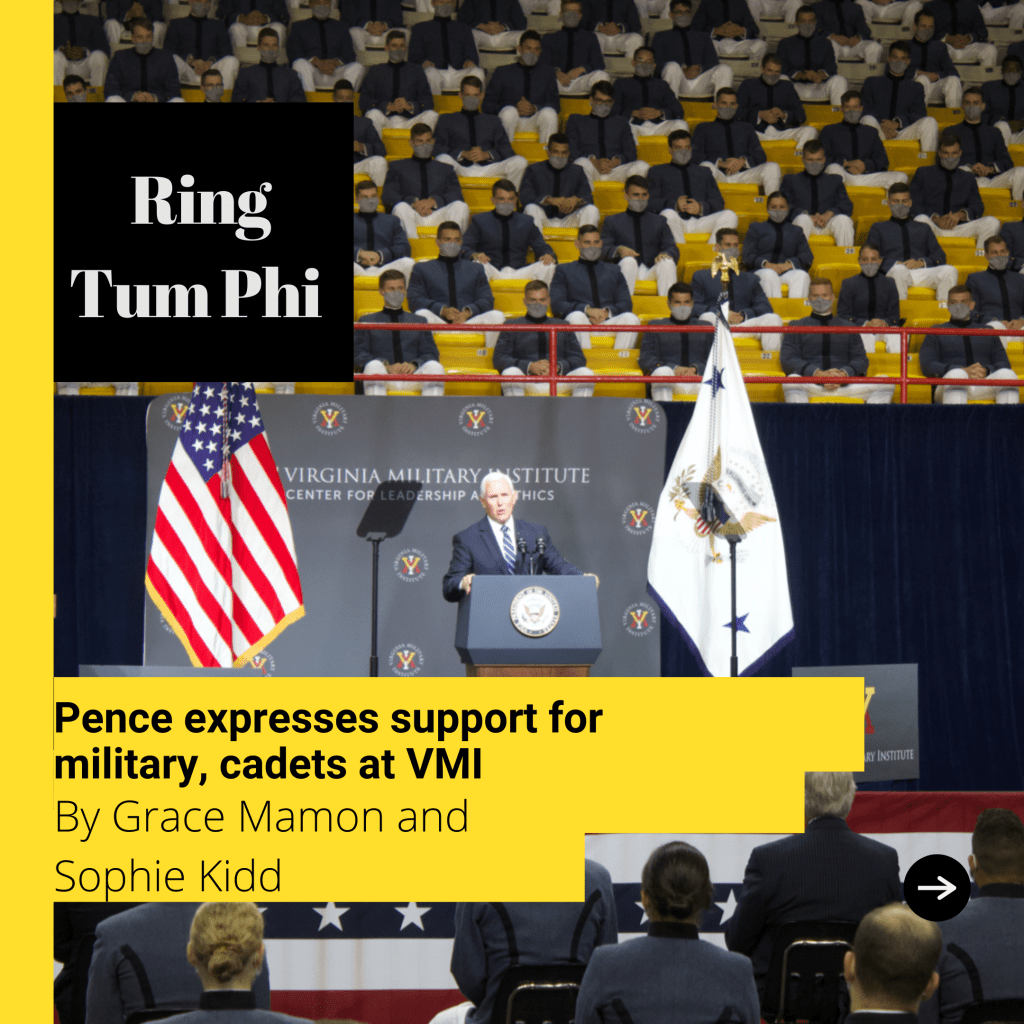
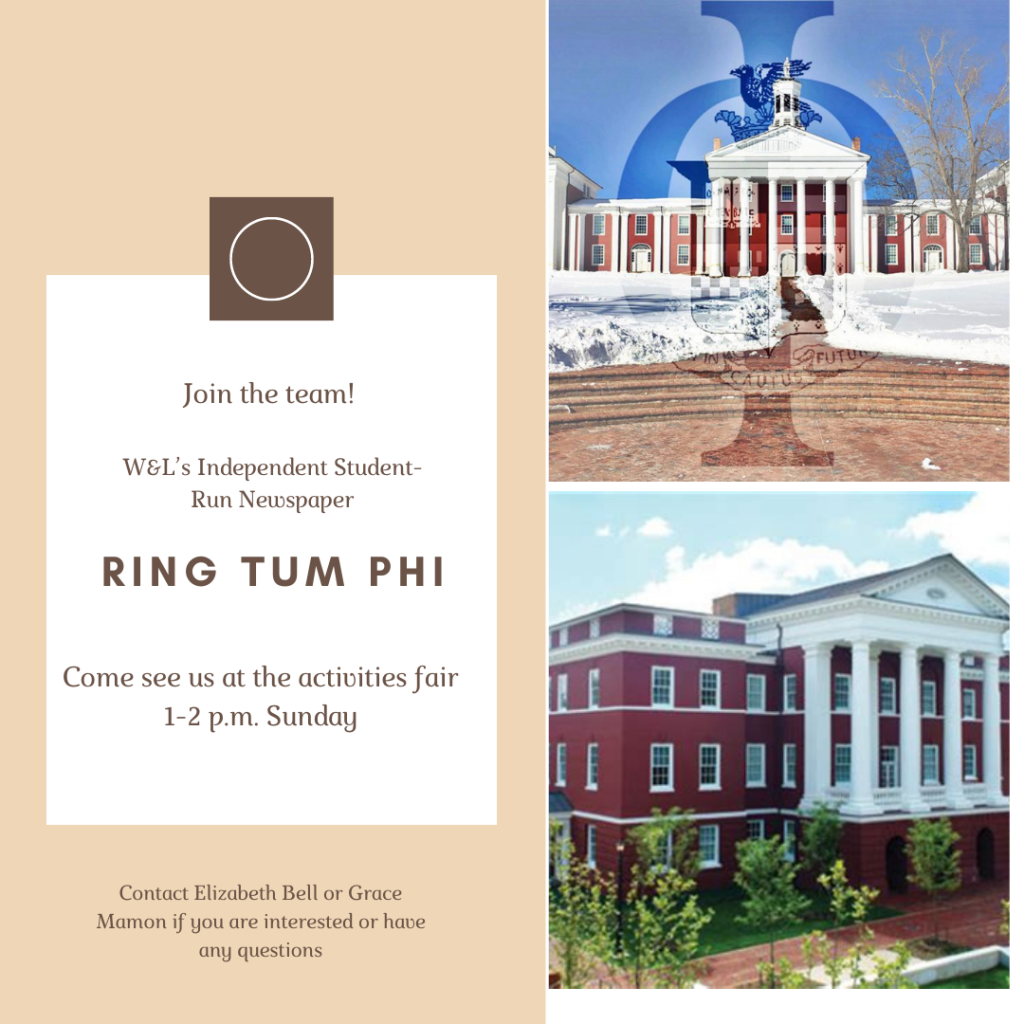
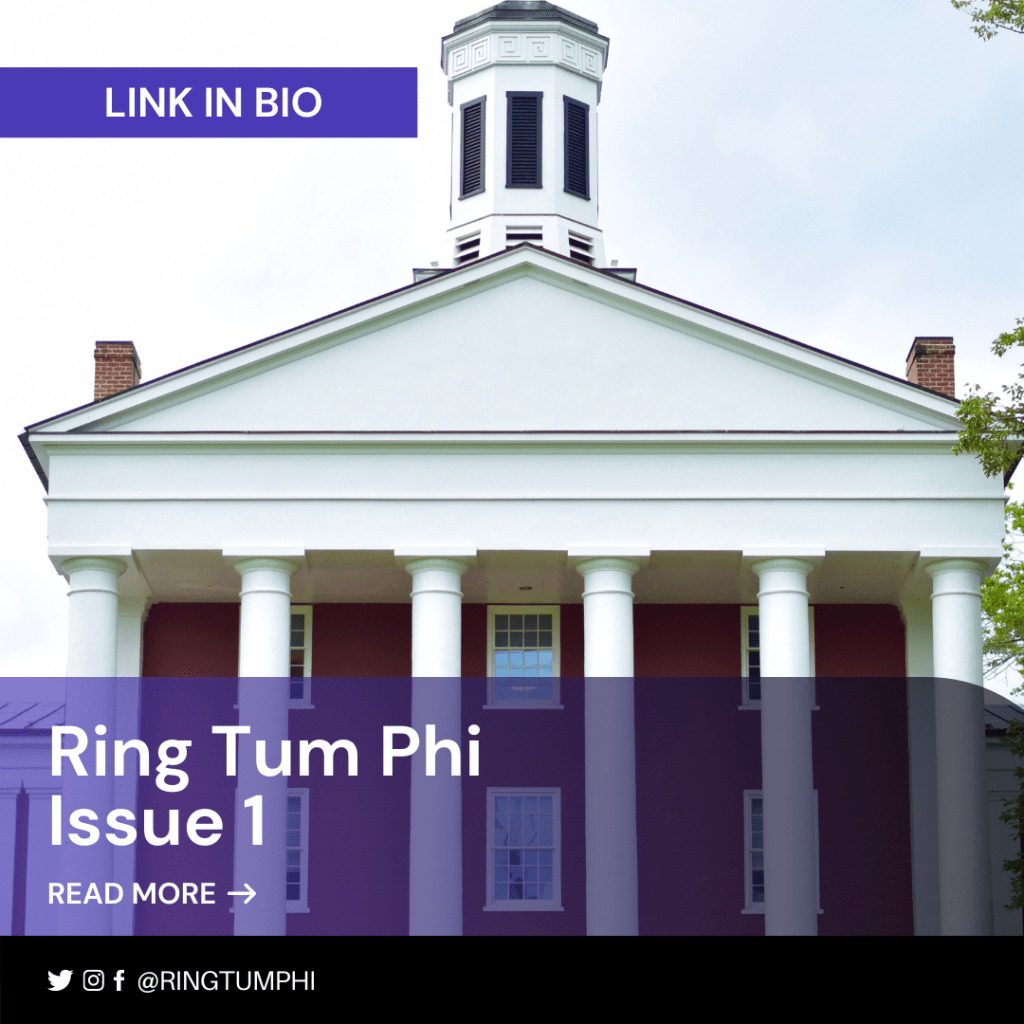
As the Social Media and Engagement Editor for the Ring Tum Phi, my job is to create content that advertises the paper and encourages readers to pick up a copy of each issue. Visit @ringtumphi to see more content.

Washington and Lee’s First Year Orientation Committee

I am FYOC’s Instagram Chair, so I am tasked with engaging incoming students with each other and making them familiar with our campus before they move in. For multimedia content including stories and video, visit @wlufyoc to see more of my work.

The Gennies’ Daily at Washington and Lee

For my social media class during Winter of my senior year, we were tasked with running accounts for @thegenniesdaily on TikTok, Snapchat, Instagram, Facebook, and Twitter. Our main focus was to display student voices on campus with professional quality content. Visit @thegenniesdaily to see more examples.

Video Packages

Video Packages

###

Both of these broadcast packages were made for my digital journalism class during Winter 2020. The first was on a noise ordinance in Lexington, VA and the tensions between local residents and W&L students. I interviewed members of the community as well as various students and leaders of student organizations that were trying to mitigate the situation. The second video features Karen Katz, a singer at W&L and her experiences, practices, and performances. They both display my video and audio editing skills.

Communications Audit: Project Horizon

Communications Audit: Project Horizon

Introduction:

This audit is a comprehensive review of Project Horizon’s internal and external communications. Kaitlyn Kaufman, a member of Project Horizon’s community outreach team, provided an in-person interview, as a well as an on-site tour to gain context about what Project Horizon is and what the goals are. An online survey was sent out to employees and volunteers at Project Horizon to assess the internal communications within the organization. Social media platforms Instagram, Facebook, and Twitter were used to analyze social media communication. To respect the privacy and safety of those who Project Horizon help, no clients were interviewed or fielded for information on internal communications.

Situation Analysis:

Project Horizon is a non-profit organization that focuses on helping victims of domestic abuse and sexual violence in Rockbridge County, Virginia. Unlike traditional for-profit organizations, Project Horizon has two primary target audiences. One primary target audience is low-income, rural women and children who are at risk of being abused. This target audience is typically not highly educated and may not have as much access to digital forms of media. Although the demographics of Rockbridge County are predominantly Caucasian, they do have special outreach programs for women and children of color. Similarly, Project Hrozion also offers support for college women or any other women in the Rockbridge area who are experiencing abuse. The other primary target audience is members of the community with resources to volunteer or donate to Project Horizon. Given that it is a non-profit, it needs the help of community members to continue helping people in need. This target audience is highly educated and of a higher socio-economic status. Ms. Kaufman’s goals for communication are name recognition and volunteer recruitment. She wants people to recognize PH’s name so that, if they need help, they know where to go. On the other side, PH wants people to donate time or money to help it continue running its operation. 

External Communication

Social Media Use

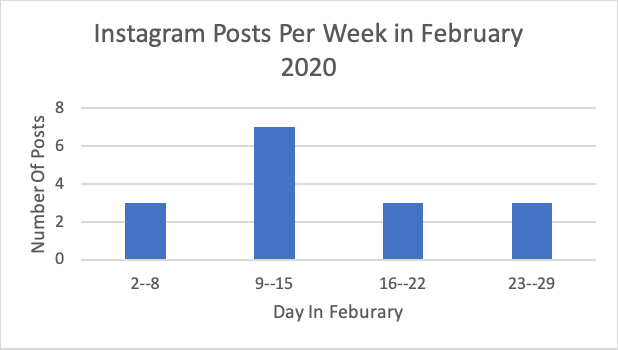
Ms. Kaufman outlined that social media, while being an important aspect of its overall external communications, is not somewhere that Project Horizon feels they need to improve. The social media platforms they predominantly use are Facebook, Instagram, and Twitter. Its Instagram (@projecthorizon120) has a consistent visual brand.  They intersperse inspirational and empowering quotes such as “you deserve love” with infographics to spread awareness about domestic abuse. The posts are always colorful and engaging, even when they reference difficult topics. They don’t seem to have a consistent posting schedule, but they do post regularly. The data visualization below depicts its posting over the month of February.

Some of its highest engagement (likes and comments) are in its infographics because they serve as being both educational and visually appealing (averaging about 60 likes per post). Its announcement posts, while necessary, do not get as much engagement (sometimes as low as 12 likes per post). On Facebook, Project Horizon seems to have identical content as Instagram. Twitter (@projecthorizon2) also posts identical content to Instagram and Facebook. However, similar organizations in Lexington such as Yellow Brick Road (a children’s education program), do not even have social media. Therefore, Project Horizon’s social media use is already more advanced than its competition. 

Website

The Project Horizon website clearly outlines the goals of the organization and makes services easy to reach. Its 24-hour hotline is bolded across the top the audience knows exactly how to reach them for personalized assistance. The 24-hour hotline allows people in crisis to contact Project Horizon and get immediate help. The website also features sections such as “volunteering” and “donations” which allow visitors to get involved without needing to search for that information. Much like its Facebook page, the website includes an “events” tab where visitors, who may not be on Facebook can view upcoming events. 

Tangible Communication

Project Horizon communicates using fliers and posters in the bathrooms of schools and grocery store to reach women and/or children, who may not have access to social media. One of Project horizon’s most unique and effective forms of communication is the merchandize that volunteers distribute. Items such as phone wallets, phone pop-sockets, and refrigerator magnets with Project Horizon’s name and phone number are given out for free, so that they can increase its name-recognition in a tangible way. For its rural target audience, this method of communication may have more traction than social media, because people who do not have consistent internet or do not want their abusers to know that they are searching for Project Horizon on the internet. Also, items such as the refrigerator magnet may foster communication similar to word-of-mouth in which people see the magnet on their friends’ fridges and then remember Project Horizon’s name.

Recommendations for External Communication

Although email is a key aspect of its internal communication, the Project Horizon team does not use any form of email for external communication such as a newsletter. According to Ms. Kaufman, several donors and volunteers have mentioned a desire for such a newsletter. A monthly newsletter to update the public on what Project Horizon is doing and its accomplishments could be helpful to keeping both target audiences involved.  The newsletter could be both in email form and printed to reach the largest audience.

Similarly, posting more unique content to Facebook and Twitter rather than just reposting the same content on all three platforms could be an effective method of getting its message out to reach different people. For example, Facebook lends itself to longer text, so even having an online newsletter posted on Facebook could work. Twitter only allows for short text, so Twitter could be for announcements. The Instagram page is currently very effective, but its visuals are only really effective on Instagram. The content doesn’t necessarily translate to the other platforms.

The Project Horizon website has all of the content that it needs; however, the aesthetics of the website could be improved and modernized. More clean and simple graphics with fewer tab options would make the website easier to navigate.

One area that Project Horizon is very strong in is its use of tangible communication. The phone accessories and magnets encourage people to know exactly what it is and what it does. Flyers in bathrooms are a great way to let women with limited resources know how to contact Project Horizon in a safe way. One opportunity for PH to improve and reach more of its rural target audience is to put up flyers in churches in the area or have seminars describing what it does. 

Internal Communication

Overall Effectiveness

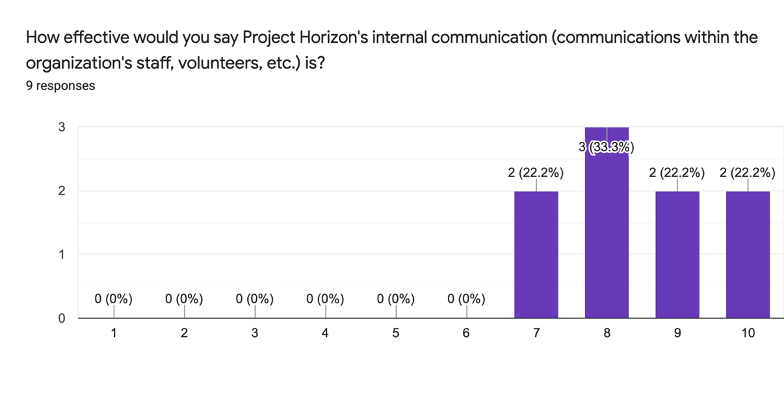
A Google Form was used to ask employees and volunteers of Project Horizon about their thoughts on Project Horizon’s communication.  All nine people who took the survey classified Project Horizon’s communication as being very effective. When asked to rate its effectiveness on a scale from 1-10, all responses fell in the range of 7-10, with the most responses for 8. This data is on the chart below. This means that the majority of employees believe Project Horizon to be very effective at internal communication, but there is still room for some improvement.

Online Communication

When asked what forms of communication are used most often, all nine responses said that email was the most used. Email is a very productive tool for formal communication among organizations, but it does have some limitations. While all nine respondents said that they felt email was an effective method of communication, many also asked for another form of direct communication that is more private.

Respondents also mentioned use of the volunteer management platform GivePulse. GivePulse allows for volunteers and organizations to track hours and post volunteer opportunities. No respondent gave details about the benefits or detriments of this platform, but it seems to be productive for the organization to advertise themselves and keep track of how volunteers are doing.

Other Forms of Communication

One weakness in terms of internal communication for Project Horizon is the usage of in-person and paper communication without any online follow-up. Three out of nine respondents to the Google Form mentioned that many times they were given sticky notes or reminders in person that they lost or forgot. All three classified this communication as “least effective.”

Recommendations for Internal Communication

Much like with external communication, an in-house newsletter could be a good tool to foster employee relations and a culture of open communications. This could be weekly or even monthly and would include what each member of the team has been working on, major projects, important news and events, and even volunteer introductions or events.

Another recommendation would be to implement another messaging tool separate from email. Given the subject matter that many Project Horizon team members discuss, a more protected communication method such as WhatsApp for individual messaging or Groupme for group messages could be a valuable tool.

 Seven out of nine respondents asked for some form of online calendar instead of the whiteboard calendar that is currently used. An  app such as Google Calendar or Outlook could be efficient for putting up staff hours, appointments, and meetings, so people can access them anywhere online.

It would also be advantageous to focus more on online communication rather than paper notes and in-person communication so information can be conveyed more efficiently. A program such as Slack, which is an instant messaging platform for workplaces, could fix many of these internal communication problems for Project Horizon. It would able them to communicate individually and as a group in a private format that cannot be accessed by outside persons. It would also allow for announcements and events to be published to the entire organization, to limit the use of the whiteboard calendar. Instead of leaving a note for a colleague, an employee could just send a message on Slack.

Conclusions

Project Horizon is relatively advanced with all forms of external communication compared to similar non-profit organizations. However, improvements could definitely be made in terms of creating a newsletter, broadening social media content, and increase online internal communications.

###

This project was made during my Public Relations Writing class. I did a communications audit for our community partner, Project Horizon, a domestic and sexual violence resource organization in Lexington, VA. This audit included their internal and external communications, as well as interviews from members of the organization and their volunteers.

Washington and Lee University Community Still Flourishes Off Campus

Washington and Lee University Community Still Flourishes Off Campus

By Emma Thai

Since classes were moved online in mid-March, W&L students have been experiencing an unprecedented school environment. Campus is closed, but the W&L community is more connected than ever.

Greek organizations are preserving their brother- and sisterhood through social media and group video call programs such as Zoom.

Andrew Harris, Lambda Chi Alpha fraternity’s social chair, said in an interview that they are using their fraternity GroupMe and chapter Zoom calls to ensure that they all stay connected.

They are also facilitating events to keep their relationships with sororities active. Lambda had planned a mixer with Chi Omega on April 3 and decided to make it virtual, Harris said.  

“We’ve had one virtual zoom mixer,” he said. “We thought that it would be fun to replace it and do it online to give people something to do and we ended up getting a pretty good turnout”

Lambda also plans on holding their Spring Term formal over zoom.

Kappa Alpha Theta sorority is finding innovative ways of staying connected too. But unlike Lambda, they are choosing to focus more on social media.

Ann Douglas Lott, who is responsible for Theta’s Instagram page, said that they wanted to give members the chance to uplift the seniors and give them a proper goodbye by making a post for each graduating senior. Other sorority members comment their favorite things about them.

“A bunch of our seniors aren’t going to have that same senior experience everyone talks about, so we are doing online shoutouts,” Lott said. “Not only to make them feel appreciated but to keep everyone else connected and keep supporting them.”

She has also started making birthday posts over Instagram stories for every Theta whose birthday happens while they are staying-at-home.

“Because we are in isolation, it feels like you don’t have that same connection to people that you do on campus,” Lott said.  “If it’s your birthday and you’re in isolation, that’s going to be terrible, so that (Instagram posts) is one thing to help you keep connected to your friends back at school.”

W&L’s Panhellenic Council focuses on bridging the gap between otherwise divided sororities. Margaret Shetler, Panhel’s programming chair, said they were concerned with how isolation could keep people from spending valuable time with women from other sororities.

She came up with the idea of having a positivity exchange, where women from different sororities are matched to be like positivity “pen-pals.” The idea is that they would exchange uplifting messages to support each other during these difficult times.

“It’s hard to keep people engaged, especially if we’re not all on campus,” Shetler said. “We just wanted to foster those relationships that don’t get the chance to form since we’re not all together”   

Shetler hopes to get more women involved to make as big of a difference as possible.

But Greek life is not the only aspect of campus culture still thriving.

The GroupMe group for independent students looks almost identical to that of a fraternity or sorority. Members discuss the housing lottery, class registration and which professors to avoid.  

Nicholas Nguyen is a first year who is in the GroupMe group said it’s mostly used for random questions from other students.

“People don’t hang out on that GroupMe, he said. “People just kind of pop in ask a question, pop out”

The fraternity and sorority GroupMes function in a similar manner. No one is trying to talk to their best friends, they just use it as a resource. Community is not just about talking to your friends; it’s also about the important day-to-day, potentially less-interesting discussions students have with each other.    

Friday Night Underground or FUDG is a place where every student is welcome to come together and watch live music performances. FUDG Director Micah Holcomb said that they wanted to maintain the core values of FUDG while moving online.

“It’s really all about having a space that is truly the entire student body’s space,” he said.

To achieve an inclusive and interactive space online, Holcomb decided to use Instagram live to reach as many students as possible.

“Having a live version was actually pretty important to us when we’re trying to preserve as much as we can to transplant online,” he said.  

Holcomb said that some alums have even begun to tune in and have been excited to relive FUDG. He said that they will try to use social media to keep alums and current students more connected when FUDG returns to in-person events.

“I think the unique thing about FUDG is we have the flexibility to do this like that,” Holcomb said. “I like to think we’re really responsive to the student body and want they enjoy.”

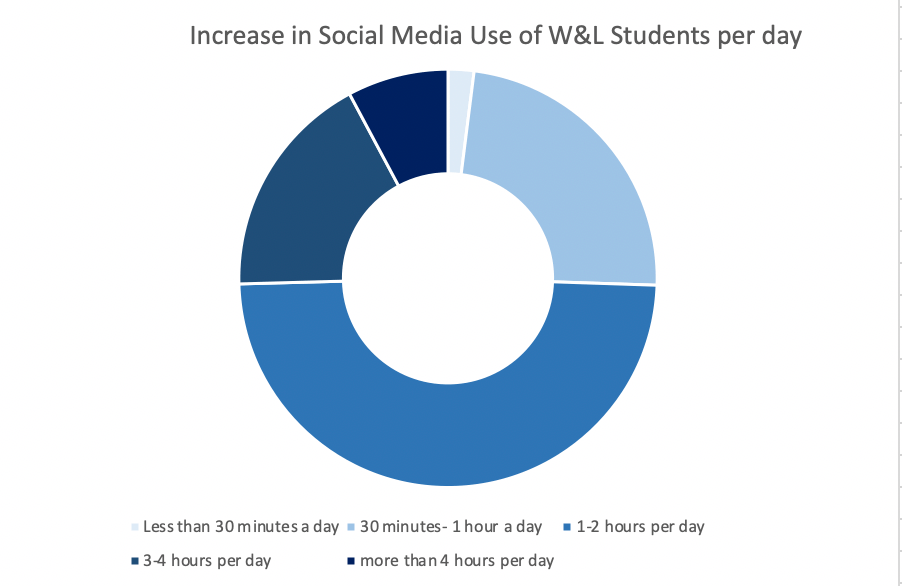
Students are enjoying social media more than ever. In a Google Form about social media use that went out to various W&L students from all Greek organizations and club affiliations, 85% of respondents said that they used social media more often than while on campus. 54 students filled out the survey.

Similarly, as seen in the visualization below, most students are using social media for at least one more hour per day than usual.

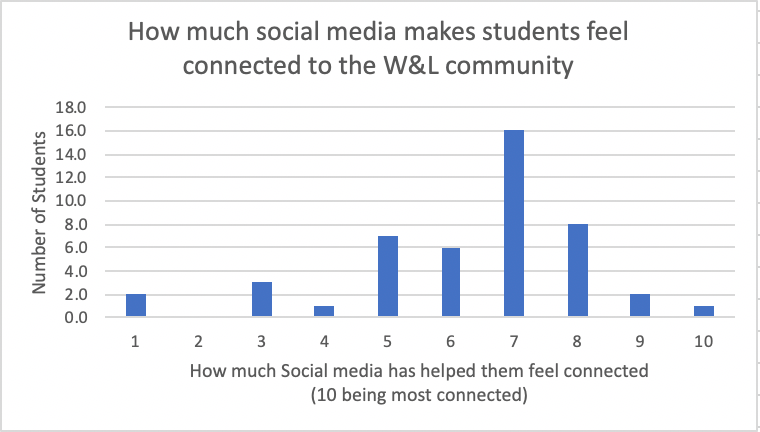
That data alone does not show that they are consuming W&L-related content. But, as seen in the bar chart below, most students who took the survey thought that social media was helping them stay connected to the W&L community.

While an Instagram post or Zoom meeting can’t fully emulate the feeling of being on campus, it does make students value what they have. If nothing else, being off campus has reminded students what truly makes Washington and Lee a special place: the people.

When asked what he missed most about W&L, Holcomb put it best, “It’s not about the services we provide for each other. It’s just about each other.”

###

This article was written for my digital journalism class when we were sent home in Spring 2020. We had to write a multimedia piece on the W&L community, so I chose to write about the W&L community during COVID, and how people chose to cope. There is also an audio component at the beginning. This project was more than just about writing, it also demonstrates my audio and data visualization capabilities.

During its Online Transition, Washington and Lee Professors are Focusing on Maintaining Both Grades and Community

During its Online Transition, Washington and Lee Professors are Focusing on Maintaining Both Grades and Community

By Emma Thai

After COVID-19 forced Washington and Lee University to switch to remote classes, professors and administrators are trying to keep the hallmark small classes and professor relationships alive, while also maintaining academic rigor.  

During a Zoom interview, Paul Hanstedt, the Director of W&L’s Center for Academic Resources and Pedagogical Excellence, said that he is encouraging W&L professors to maintain normalcy in their classes. He thinks that professors should focus on showing their personalities, even in the online classroom.

“I’m encouraging people to allow their sense of humor to come out,” Hanstedt said. “Whatever they used in the classroom to make the classroom work should appear in their emails, should appear in their videos.”

On March 13, W&L announced that students would have to move home by March 18, unless they received special permission to stay. Classes resumed remotely two weeks later on March 30 to give professors time to plan for the change.

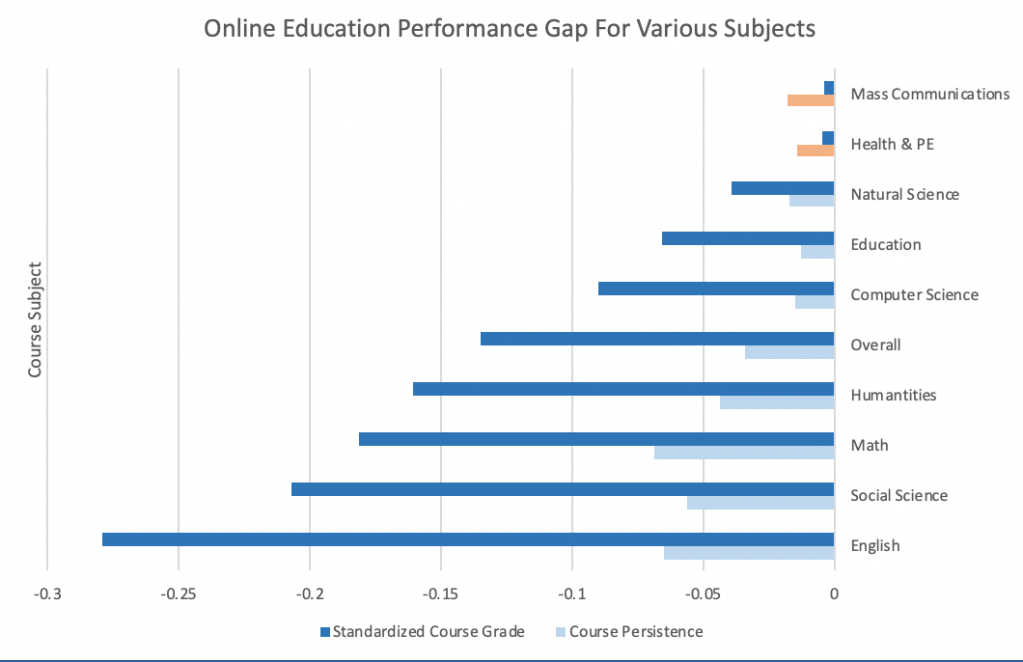
A study published in the Journal of Higher Education on community colleges in Washington state found that online higher education leads to reduced student performance in every subject. Performance was measured by change in grade and change in student persistence, which was determined by how many students withdrew from classes.

While this study does not necessarily translate to W&L’s transition to online classes, it does show how much online classes could have an impact on students.

According the study, mass communications and physical education were the only two subjects with almost the same outcomes in online and face-to-face classes.

Jessica Miller, who teaches W&L’s Interpretive Movement P.E. class, believes that classes like hers are beneficial to students while at home.

“Students have said it has been helpful in grounding them in uncertain times,” she said in an online interview. “My class has a focus on mental clarity as well as movement and students say it given them a sense of relaxation and helped them sleep.”

Although P.E. and journalism are not similar in terms of content, they both focus on action and skills rather than just information.

Professor Douglas Cumming of the Journalism and Mass Communications Department, is grappling with keeping the rigor of Journalism 201: Introduction to News Writing remotely. Journalism 201 includes a combination of in-class writing labs and lectures so that students learn how to effectively write for news.

Cumming changed the class so students were focusing more on the in-class writing labs and feedback than lectures. He actually thinks he and his students are able to commit more time and energy to the course being at home.

“I do think the pedagogy in some ways is even richer,” he said in an interview over Zoom yesterday. “I feel like I can spend more time emailing and editing student work. I’m actually excited about some of the new possibilities.”

When asked about the data in the study, Cumming mentioned that the data on student grades are not a good model for W&L because many professors will not grade as harshly due to the unforeseen circumstances. The study only accounted for students who chose to take online or in-person classes, but W&L students and professors did not have a choice.

“I feel like I’m being more generous with grading,” he said. “It was sudden, and we were thrust into this, so it’s nobody’s fault if there are difficulties.”

W&L will let students choose to take classes credit/no-credit with no impact on their GPA to account for unexpected grade changes.

Professors and administrators also have the added layer of W&L students feeling socially isolated while staying at home.

Julia Gallop is a W&L student who understands remote learning better than most W&L students. After a vacation to Italy over Washington Break, Gallop and her friend Paige Hammele were quarantined at W&L and not permitted to attend classes or be around other students for two weeks.

Gallop said that she felt isolated, both in the classroom and socially. When asked what she missed most, Gallop responded, “I really missed my friends. I missed social interaction in general.”

In order to offset this social isolation, Hanstedt wants professors to cultivate the same relationships they’ve always had with students.

“Yes, you want to establish the structures of the course,” he said. “But, also, you need to reestablish the relationships.”

Cumming had the same outlook on how important relationships with students are.

“What’s unique and what’s definitive about liberal arts is the relationships between professors and students,” he said. “The learning is what happens in between.”

But Hanstedt said that a lot of his work was made easy because of the intelligence and drive of the W&L community.

“One of the real pleasures of this is watching really smart people and really smart teachers innovate and come up ways to handle things,” he said. “It’s impressive. It really is.”

Works Cited

Xu, Di and Shanna S. Jaggars. “Performance Gaps Between Online and Face-to-Face Courses: Differences Across Types of Students and Academic Subject Areas.” The Journal of Higher Education, vol. 85 no. 5, 2014, p. 633-659. Project MUSEdoi:10.1353/jhe.2014.0028.

###

This article was written in April 2020 during my digital journalism course. I conducted all the interviews and research via Zoom since we were remote. I initially created this whole website to host this article, so I had a place to display all my multimedia work together.